




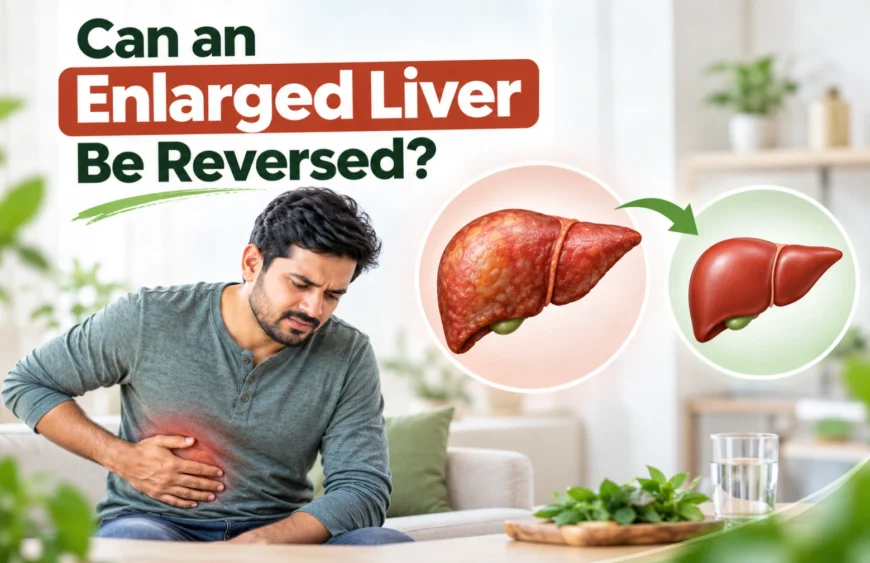
Did you get an ultrasound report that says “enlarged liver” or “hepatomegaly” and now you’re worried? Don’t worry; take a breath. In most cases, an enlarged liver can return toward its normal size. But it only happens if you get the treatment at the right time and get treated properly.
I’m Dr. Kalpit Acharya, an Ayurvedic surgeon, and this is the first thing I tell patients who walk in with that report: an enlarged liver is not a disease; it is a sign that something is affecting your liver health, and you should be aware of that before it leads to something critical. You should take precautions so it will return to it’s normal size.
Table of Contents
- What Does an Enlarged Liver Mean?
- What Exactly Causes an Enlarged Liver?
- Can an Enlarged Liver Be Reversed?
- What Are the Early Symptoms?
- How Is an Enlarged Liver Diagnosed?
- How is The Enlarged Liver Treated?
- The Ayurvedic View of Liver Enlargement
- How Long Does Liver Enlargement Recovery Take?
- When Should You See a Doctor Urgently?
- Verdict
What Does an Enlarged Liver Mean?
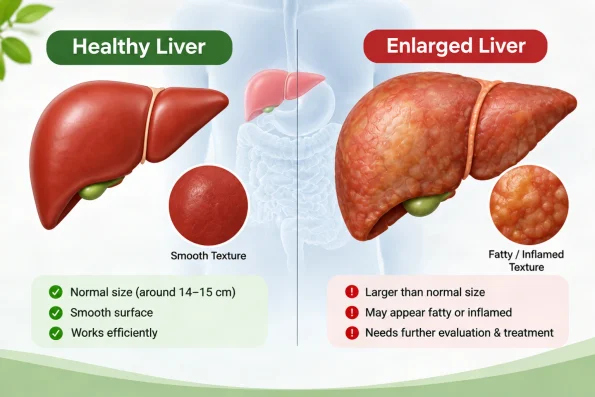
An enlarged liver also known as (Hepatomegaly) which means your liver is bigger than expected for your age, sex and body build. When normally checked on ultrasound, a healthy adult liver usually measures around 14 to 15 cm, but this varies from person to person. So the number on your report should always be read along with your symptoms, examination and blood tests.
For example, think of it like you got a swollen ankle. If you check, the swelling tells you something is wrong, but not what. It could be an injury, an infection, or a circulation problem. Your liver also works the same way.
What Exactly Causes an Enlarged Liver?
Finding the exact cause of an enlarged liver without any medical check is tough but there are some common issue that maybe a cause of enlarged liver which are :
- Fatty liver (MASLD, earlier called NAFLD): Extra fat builds up in the liver, often linked to weight gain, diabetes, high cholesterol, or insulin resistance. It can also happen in lean people, and it is the most common cause I see.
- Alcohol-related liver disease: Alcohol damages liver cells and causes inflammation and fat deposits.
- Infections: Viral hepatitis (especially B and E in India), malaria, typhoid, and other infections can swell the liver.
- Heart problems: In conditions like heart failure, blood backs up and congests the liver.
- Cysts and tumours: These need a completely different treatment from fatty liver.
- Medicines and unregulated products: Self-medicated painkillers and herbal “liver tonics” of unknown composition can injure the liver.
- Rare inherited conditions: Such as iron or copper storage disorders.
Most people assume an enlarged liver means a fatty liver. Well, it doesn’t, and that assumption is the main reason people delay the right diagnosis.
Can an Enlarged Liver Be Reversed?
Yes, absolutely, an enlarged liver is totally reversible, but it depends on what caused the enlarged issue and on how much permanent damage the liver has already taken. Enlargement caused by different issues takes different time to get reversed like:
- Infections and acute inflammation: Usually settle once the underlying problem is treated.
- Fatty liver: Often improves a lot with steady weight loss, regular exercise, and better control of sugar and cholesterol.
- Alcohol-related injury: Can improve considerably once alcohol is stopped, if caught before scarring sets in.
- Chronic liver disease: This is where I am honest with patients. Long-standing damage can lead to scarring (fibrosis) and finally cirrhosis. Established cirrhosis cannot be cured by a detox diet or supplement. But once the cause is controlled, for example, hepatitis treated or alcohol stopped, the liver can stabilise, and early scarring may partly improve.
The liver has a remarkable power to repair itself, but that power has limits. How healthy the liver tissue is matters more than its size alone.
What Are the Early Symptoms?
Spotting enlarged liver symptoms is the tricky part: many people feel nothing at all, and the enlargement is found by chance. When symptoms do appear, they may include:
- Fullness or discomfort in the upper right abdomen: The swollen liver presses against the surrounding tissues under your right ribs.
- Bloating or abdominal swelling: Fluid or a larger liver can make the belly look and feel tight.
- Tiredness and low appetite: A stressed liver struggles with energy and digestion, so you feel drained and less hungry.
- Nausea: Poor bile and digestive function can leave you feeling queasy, especially after meals.
- Itching: Bile substances build up in the blood and irritate the skin.
- Yellow eyes or skin (jaundice): The liver isn’t clearing bilirubin properly, so it settles in the eyes and skin.
- Swollen legs: Poor liver function or blood congestion lets fluid collect in the legs and ankles.
None of these is specific to the liver, so symptoms alone can’t tell you the cause. That’s why medical testing is recommended.
How Is an Enlarged Liver Diagnosed?
When diagnosing enlarged liver most doctor follows the same procedure starting by listening to patient then Questions about alcohol, medicines, supplements, weight changes, diabetes and past infections often point toward the cause. Once the doctor confirms all these, they do the following:
- Blood tests check liver enzymes and liver function
- Ultrasound shows size, structure, and fat
- CT or MRI is added when the picture isn’t clear
- Elastography (a scan that measures liver stiffness) checks for scarring
- Biopsy is needed only in selected cases
How is The Enlarged Liver Treated?
When doctors treat enlarged liver, there is no single medicine for an enlarged liver. Treatment follows the root cause of liver enlargement:
- Infection: If it is caused by infection, treat the infection
- Alcohol-related injury: If it is caused by alcohol, stop alcohol completely
- Fatty liver: weight management, exercise, and control of diabetes, blood pressure, and cholesterol
- Heart-related congestion: treat the heart condition
- Cyst, tumour or blockage: specialist evaluation, sometimes a procedure
The Ayurvedic View of Liver Enlargement
In Ayurveda, liver enlargement is often described as Yakrit Vriddhi. It is understood through Ayurvedic concepts such as aggravated Pitta and disturbances in Raktavaha Srotas, which refers to the channels associated with blood circulation.
Now, you must be thinking, how does Ayurveda approach liver health? Well, the focus is not just on taking herbs. It also involves correcting your daily routine, eating habits, and lifestyle.
For example, try to include light, healthy, freshly cooked food in your meals, maintain regular meal timings, and stay physically active. At the same time, avoid alcohol, limit fried foods, and cut down on excess sweets. Many herbs, like Bhumyamalaki, Kutki and Punarnava, have traditionally been used in Ayurveda to support liver health. But this doesn’t mean they can reverse every case of liver enlargement or replace medical treatment. Ayurveda is here to support recovery. It is recommended to always consult with a doctor before taking any medications on your own.
How Long Does Liver Enlargement Recovery Take?
There is no fixed timeline or guarantee of recovery for liver enlargement issue. A temporary cause may settle within weeks, while serious conditions can take months or even longer. Sometimes the disease is controlled even though the liver doesn’t return to its exact earlier size. So don’t judge your progress by one scan. Look at the whole picture: your blood tests, your symptoms, and your follow-up reports.
When Should You See a Doctor Urgently?
An enlarged liver always deserves immediate attention. Seek medical help right away if you see symptoms like:
- Yellow eyes or skin
- Severe or persistent abdominal pain
- Confusion or unusual drowsiness
- Persistent fever or repeated vomiting
- Vomiting blood, or black or bloody stools
- Rapidly increasing abdominal swelling
Verdict
An enlarged liver can often be reversed, but only when the cause is found and treated. In some people, the liver returns to normal. In others, especially with long-standing damage, the aim is to stop progression and protect the liver function that remains.
So if your report says “enlarged liver,” don’t start with a liver cleanse or a supplement. Start with finding the cause, then build your treatment, diet, and lifestyle around it.