




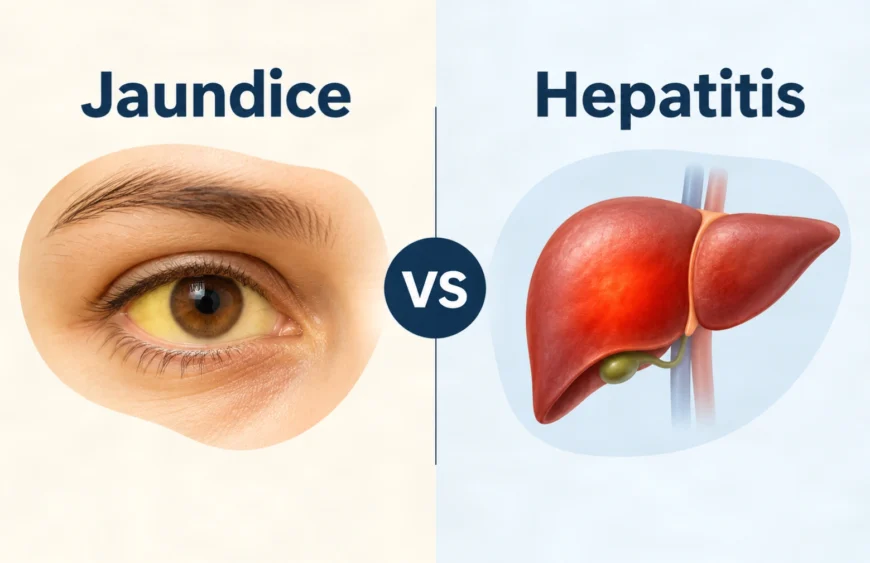
Have you ever heard someone say they have jaundice, while another person calls the same problem hepatitis? These words are often used as if they mean the same thing. But medically, there is an important difference.
Jaundice is the yellowing of your skin or the whites of your eyes because bilirubin builds up in your body. Hepatitis means inflammation of the liver. Hepatitis can cause jaundice, but not everyone with hepatitis turns yellow. You can also have jaundice without having hepatitis.
Now, you may be thinking, if the symptoms look similar, how do you know which problem you have? Let’s understand what each term means, how they are connected, and why finding the cause matters.
Table of Contents
- What Is the Difference Between Jaundice and Hepatitis?
- What Does Jaundice Mean?
- What Does Hepatitis Mean?
- Can You Have Jaundice Without Hepatitis?
- Can You Have Hepatitis Without Jaundice?
- Which Symptoms Can Occur With Jaundice and Hepatitis?
- Is Jaundice Contagious?
- How Do Doctors Find the Cause?
- How Does Treatment Differ?
- When Should You Seek Medical Attention?
- Common Questions About Jaundice and Hepatitis
- Verdict
What Is the Difference Between Jaundice and Hepatitis?
The main difference between jaundice and hepatitis is that jaundice describes a visible sign, while hepatitis describes inflammation inside the liver.
| What you are comparing | Jaundice | Hepatitis |
| Meaning | Yellowing caused by excess bilirubin | Inflammation of the liver |
| What causes it | Problems with bilirubin production, processing or drainage | Viruses, alcohol, certain medicines, autoimmune disease and other causes |
| Are yellow eyes always present? | Yellowing is the defining sign, although it may be subtle | Yellowing may be present or absent |
| Can it spread to others? | Jaundice itself does not spread | Some viral causes can spread |
| Treatment approach | Find and treat the underlying cause | Identify and treat the cause of inflammation |
These are not two competing diagnoses. A person may have both at the same time.
What Does Jaundice Mean?
Jaundice happens when there is too much bilirubin in your blood. Bilirubin is a yellow substance produced when your body breaks down old red blood cells.
Normally, your liver processes bilirubin so your body can remove it. If something interrupts that process, bilirubin can accumulate and cause yellowing.
The problem may involve the liver, but that is not the only possibility. Increased breakdown of red blood cells or a blockage in the bile ducts can also cause jaundice.
Think of jaundice as a clue. It tells the doctor that bilirubin is building up, but it does not explain why. That is why simply treating the yellow colour is not enough.
What Does Hepatitis Mean?
Hepatitis means inflammation of the liver. Many people associate it only with hepatitis viruses, but inflammation is not always caused by an infection.
For example, your immune system can mistakenly attack your liver and cause autoimmune hepatitis. This is different from catching a hepatitis virus from another person.
This distinction matters because different causes need different treatment. A medicine used for one type of hepatitis may not be suitable for another.
Can You Have Jaundice Without Hepatitis?
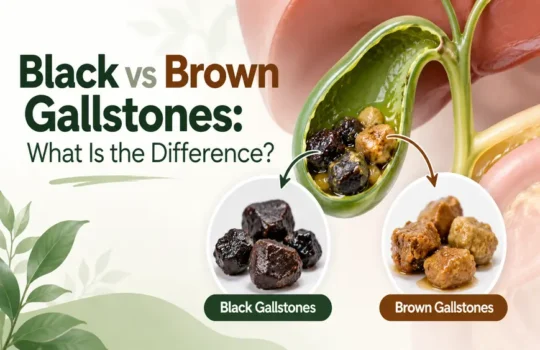
Yes. One example is a gallstone blocking a bile duct. The blockage can interfere with bile drainage and cause jaundice even when viral hepatitis is not the cause. To understand how different pigment stones form, read our guide to black vs brown gallstones.
Another example is Gilbert syndrome, an inherited condition that affects bilirubin processing. It can cause occasional mild jaundice and usually does not require treatment.
But this does not mean you should assume new yellowing is harmless. A doctor needs to establish the cause before you can know what it means.
Can You Have Hepatitis Without Jaundice?
Yes. The absence of yellow eyes does not rule out hepatitis.
For example, many people with hepatitis B do not notice symptoms. An infection may be found through screening or blood tests rather than a visible change in appearance.
So, looking in the mirror cannot tell you whether your liver is healthy. Equally, yellow eyes alone cannot tell you which liver condition you have.
Which Symptoms Can Occur With Jaundice and Hepatitis?
Yellowing of the skin or the whites of the eyes is the main sign of jaundice. Depending on the cause, you may also notice dark urine, pale stools or itching. Yellowing can be harder to see on darker skin, so changes in the whites of the eyes may be more noticeable.
Some types of hepatitis can cause tiredness, poor appetite, nausea, abdominal discomfort and jaundice. However, symptoms vary. Autoimmune hepatitis, for example, may also cause joint pain, and some people have few symptoms until the disease is discovered through testing.
The important point is that symptoms overlap. You cannot identify hepatitis A, B or another cause just by checking the colour of your urine or eyes.
Is Jaundice Contagious?
Jaundice itself is not contagious. Whether there is a risk of infection depends on what caused it.
For example, hepatitis A spreads mainly when someone ingests food or water contaminated with the virus. It is not the yellowing that spreads. It is the underlying infection.
Hepatitis B has different transmission routes, including contact with infected blood, sexual contact and transmission during birth. It does not spread through ordinary activities such as hugging or sharing food.
If someone in your family has jaundice, first find out the diagnosis. There is no single set of precautions that applies to every cause.
How Do Doctors Find the Cause?
The first step is usually a conversation about your symptoms and medical history. Be ready to explain when the yellowing started, whether you have pain or fever, and which medicines or supplements you take.
The assessment may include:
- Bilirubin testing: To measure bilirubin in your blood.
- Liver blood tests: To look for patterns of liver injury and assess aspects of liver function.
- Hepatitis tests: To check for particular infections when appropriate.
- An ultrasound: To look for problems such as gallstones or blocked bile ducts.
The exact tests depend on the situation. Not everyone needs every investigation.
Also, a high bilirubin result does not automatically mean viral hepatitis. Bilirubin can rise for several reasons, so the result needs to be interpreted alongside other findings.
How Does Treatment Differ?
There is no single treatment for every person with jaundice. Treatment follows the cause.
Hepatitis A, for example, usually needs supportive care rather than a specific antiviral medicine. Recovery involves appropriate nutrition, fluids and medical monitoring. Most people recover fully, although severe illness can occur.
Autoimmune hepatitis is different. Doctors usually treat it with medicines that suppress the immune system and reduce liver inflammation.
A bile duct blockage needs another approach. Resting or taking a general “liver tonic” will not remove an obstruction.
If you use Ayurvedic medicines or herbal supplements, tell your treating doctor exactly what you take. Do not assume that a product labelled natural is suitable for every liver condition, or use it to postpone an assessment. You can also use Hepstome-LFT Syrup, an Ayurvedic formulation for supportive liver and digestive wellness.
When Should You Seek Medical Attention?
New yellowing of your skin or the whites of your eyes needs prompt medical assessment, even if you otherwise feel well. Jaundice can be a sign of a serious condition.
Seek emergency care if jaundice is accompanied by confusion, vomiting blood, or severe abdominal pain with fever or shaking chills. These combinations can indicate serious liver disease or an infected bile duct.
Do not wait for the yellowing to become darker before asking for help.
Common Questions About Jaundice and Hepatitis
Can Jaundice Turn Into Hepatitis B?
No. Jaundice does not turn into hepatitis B. Hepatitis B is caused by a virus, and jaundice is one possible sign of the infection.
Are Hepatitis A and Jaundice the Same?
No. Hepatitis A is a specific viral infection. Jaundice is a sign that may occur during that infection, but not everyone with hepatitis A develops it.
What If Hepatitis Tests Are Negative but You Still Have Jaundice?
Negative tests for selected hepatitis viruses do not explain every possible cause of jaundice. Your doctor may investigate nonviral liver inflammation, bile drainage problems or other causes, depending on your results and symptoms.
Which Is More Serious, Jaundice or Hepatitis?
The names alone cannot tell you. Jaundice may have a relatively mild cause or signal a serious problem. Hepatitis also varies by cause and severity. The diagnosis and test results matter more than comparing the two labels.
Does Jaundice Disappearing Mean You Have Recovered?
Improvement in yellowing is encouraging, but it does not prove that the underlying condition has completely resolved. Follow the monitoring plan recommended for your diagnosis.
Verdict
Jaundice and hepatitis are connected, but they are not the same. Jaundice describes yellowing caused by excess bilirubin. Hepatitis describes inflammation of the liver. So, if you notice yellow eyes or receive an abnormal liver report, start by finding the cause. Once that is clear, treatment and follow-up can be planned around the actual problem.