




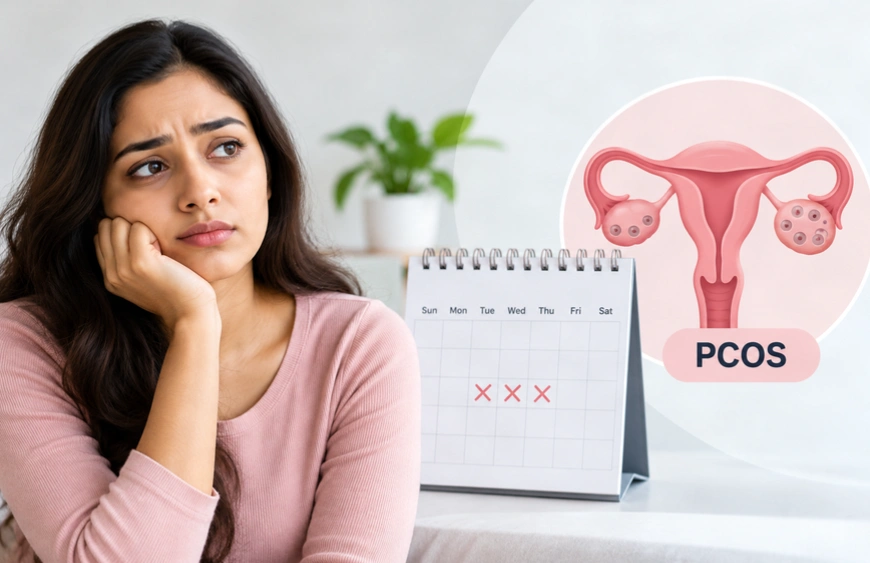
Have you been checking your calendar, waiting for your period, and suddenly realised it has been three months? If you already have PCOS, you may think this is just how your cycle works. But now you are wondering whether you should keep waiting or do something about it.
Here is the direct answer: if you have PCOS and no period for 3 months, arrange an appointment with a gynaecologist. Take a pregnancy test if pregnancy is possible. Long gaps can happen with PCOS, but they still deserve assessment and a plan to protect the lining of your womb. If you feel otherwise well, the missed period alone is usually a reason to book an appointment, rather than panic.
Now, this does not mean your PCOS has suddenly become severe or that you cannot get pregnant. It means we need to understand why the period is missing and what your body needs next.
Table of Contents
- What Should You Do First If Your Period Is Three Months Late?
- Why Does PCOS Stop Your Periods?
- Why Do Three Months Without a Period Matter?
- What If You Are Using Hormonal Contraception?
- Could Something Other Than PCOS Be Causing This?
- What Will the Doctor Check?
- How Are Missed Periods With PCOS Treated?
- Can Lifestyle Changes or Ayurveda Bring Your Period Back?
- When Should You Get Urgent Medical Help?
- Common Questions About PCOS and Missed Periods
- Verdict
- Sources
What should you do first if your period is three months late
Before trying another home remedy or taking a tablet you used last year, start with these steps.
- Check for pregnancy if it is possible. PCOS can make ovulation unpredictable. It does not stop pregnancy from happening. If you cannot predict when your period is due, take a home test at least 21 days after the last unprotected sex. A test taken earlier may need repeating.
- Book a gynaecology appointment. Tell the clinic it has been around 90 days since the start of your last proper period, and mention any spotting, pain, medicines or contraception.
- Write down what has changed. Bring your cycle dates, pregnancy test results, current medicines and supplements, and details of recent illness, stress, eating changes or weight changes.
- Avoid taking period tablets on your own. A medicine prescribed for an earlier episode may not be the right choice now. The reason for the missed period, pregnancy possibility and your medical history matter.
If your pregnancy test is negative but you still think pregnancy is possible, repeat it after a few days and speak to your doctor. A negative result does not explain why your period has stopped.
Why does PCOS stop your periods
To understand this, first think about what happens during a usual menstrual cycle. An ovary releases an egg, which is called ovulation. After that, progesterone rises. If pregnancy does not happen, hormone levels fall and the lining of the womb sheds as a period.
With PCOS, ovulation may happen late or may not happen in a particular cycle. Without the usual rise and fall in progesterone, bleeding becomes less predictable. That is why a cycle can stretch from a few extra weeks to several months.
In simple terms, your period is not necessarily stuck inside you waiting to come out. The hormonal sequence that normally brings it on has been disrupted. Trying to force bleeding with a food or drink does not tell you why that sequence changed.
Insulin resistance and higher androgen levels can contribute, but the pattern is different for every person. Having a missed period also does not prove that PCOS is the only reason.
Why do three months without a period matter
The concern is not only about the calendar. With long gaps between periods and ongoing exposure to oestrogen without enough progesterone, the womb lining can become too thick. Doctors call this endometrial hyperplasia. Managing long gaps helps protect that lining.
Now, you may be thinking, does this mean I have cancer? No. Three months without a period does not diagnose cancer or even prove that your lining is thick. The international PCOS guideline explains that although the risk is increased, the overall chance of endometrial cancer remains low. Routine cancer screening is not recommended for everyone with PCOS.
The useful response is to get assessed and agree on a plan, rather than wait for another few months because someone online went longer without a period. Your doctor considers your bleeding history, medicines and other risk factors, not just one cycle length.
What if you are using hormonal contraception
This is an important exception. Missing a natural period because you are not ovulating is different from having little or no bleeding on a hormonal method that keeps the womb lining thin.
For example, a hormonal intrauterine system, often called a hormonal coil, can reduce or stop bleeding while protecting the lining. Some other hormonal contraceptives can also change your bleeding pattern. You do not automatically need to make yourself bleed every three months when your prescribed method is already providing protection.
Check what is expected with your specific method. If the change is new, you have missed doses, pregnancy is possible, or you have pain or unusual bleeding, contact your clinician. Do not stop prescribed contraception just to see whether your period returns.
Could something other than PCOS be causing this
Yes. Even after a PCOS diagnosis, it is possible to have another reason for missing periods. Pregnancy comes first when it is possible. Other causes include thyroid problems, high prolactin, breastfeeding, certain medicines, significant changes in food intake or exercise, stress, and changes in ovarian function.
For example, if your periods were reasonably predictable and suddenly stopped after a major change in eating or exercise, that history matters. It should not be dismissed simply because you have PCOS.
Also tell your doctor about nipple discharge when you are not breastfeeding, persistent headaches, vision changes, hot flushes or rapidly changing facial hair. These details can help decide which investigations are useful.
What will the doctor check
A visit usually starts with questions, not a long list of tests. Your doctor will ask when your last period began, what your cycles are normally like, whether pregnancy is possible, and which medicines or supplements you take.
Depending on the situation, the assessment may include:
- Pregnancy testing. Sometimes a blood pregnancy test is needed if the history or symptoms do not fit the urine result.
- Selected blood tests. Thyroid function, prolactin and reproductive hormones may help identify the cause. You do not necessarily need every hormone test.
- A pelvic ultrasound. This may help assess the ovaries and womb lining when appropriate. It is not a requirement for every missed period.
A biopsy is not something everyone with PCOS needs. If the lining is unusually thick or there are other concerning findings, your doctor will explain whether further investigation is appropriate.
How are missed periods with PCOS treated
There is no single tablet that suits everybody. The immediate question is whether your womb lining needs protection. The longer-term question is how to manage your cycle and other PCOS symptoms. Whether you want to become pregnant also changes the plan.
A prescribed course of progestogen
Your doctor may prescribe a short course of a progesterone-like medicine, called a progestogen. Bleeding can occur after the course finishes. This is called a withdrawal bleed, and the treatment can help protect the womb lining.
But a withdrawal bleed does not prove that an egg was released or that PCOS is cured. That is why a period returning after tablets is useful information, but it is not the whole picture. If bleeding does not happen after a prescribed course, contact the prescriber rather than repeating it yourself.
Ongoing cycle management
Depending on your health and preferences, options may include hormonal contraception, planned intermittent progestogen or treatment aimed at metabolic concerns. Metformin may help some people with PCOS, but it is not an instant period-starting medicine.
If you are trying to conceive, tell your doctor at the start. You can ask for a plan that addresses both the missed periods and your pregnancy goals. If you do not want hormonal contraception, say so too. There may be other ways to protect the lining that you can discuss together.
Can lifestyle changes or Ayurveda bring your period back
Healthy eating, regular movement, sleep and support for stress are useful parts of PCOS care. You do not need to follow an extreme diet or blame yourself for a missed period. Lifestyle support can benefit health even when your weight does not change.
For everyday meals, this can mean including vegetables, dal, beans, eggs or another protein source, and suitable portions of whole grains. Choose activity you can continue, such as walking and strength exercises, rather than repeatedly starting a punishing routine.
But there is no fixed number of days in which these changes will restart your cycle. If you have already reached three months without a natural period, do not postpone assessment while waiting for lifestyle changes to work.
If you prefer an Ayurvedic approach, discuss it with a qualified practitioner and tell your gynaecologist about any products you use. Traditional use of herbs such as Shatavari or Ashoka is not proof that they will reliably restart a period or protect the womb lining. They should not be presented as a substitute for assessing three months of absent periods. Explore Cyclafer Syrup, an Ayurvedic herbal formulation designed to support menstrual wellness. Follow the directions on the packaging.
The same applies to online suggestions involving papaya, herbal teas or high-dose vitamins. A period arriving after a remedy does not establish that the remedy caused it. Avoid using herbs or supplements to induce bleeding when pregnancy has not been ruled out.
When should you get urgent medical help
A missed period by itself is different from a missed period with worrying symptoms. Seek urgent medical care if pregnancy is possible and you develop one-sided lower abdominal pain, unusual bleeding or shoulder-tip pain. You can need assessment even without a positive home pregnancy test.
Go to the nearest emergency department for sudden severe abdominal pain, fainting or marked dizziness, particularly if pregnancy could be possible. Heavy bleeding that leaves you faint or very unwell also needs urgent care. Do not assume these symptoms are simply PCOS.
Common questions about PCOS and missed periods
Does brown spotting count as a period
Brown spotting is bleeding, but its colour or small amount cannot tell you whether you ovulated or whether your womb lining is adequately protected. Record the dates and amount, and tell your doctor about the full three-month pattern rather than assuming a little spotting resolves the concern.
Can you get pregnant without regular periods
Yes. Ovulation may happen unexpectedly, before another period arrives. Irregular periods are not contraception. Test if pregnancy is possible, and discuss contraception if you do not want to conceive.
Can you have cramps or white discharge without a period
Yes, but those symptoms alone do not confirm that a period is about to start. They also do not rule pregnancy in or out. Mention persistent pain or discharge with itching, an unpleasant smell or other new symptoms to your doctor. Our guide to period symptoms before, during and after bleeding explains common cycle-related changes, although symptoms alone cannot confirm that a period is about to start.
How long will it take for periods to become regular again
There is no guaranteed timeline. A withdrawal bleed after medicine is different from a return to regular ovulation. Agree on what to do if bleeding does not happen, how long to track your cycle, and when to follow up. Do not keep extending the waiting period on your own.
Verdict
PCOS can explain a long gap between periods, but three months without a natural period is a good reason to stop guessing and get checked. Rule out pregnancy when relevant, note your cycle history, and arrange a gynaecology appointment.
The aim is not just to see bleeding once. It is to understand the cause, protect your womb lining and build a plan you can follow. You do not have to solve everything today, but you should know what your next step is.