

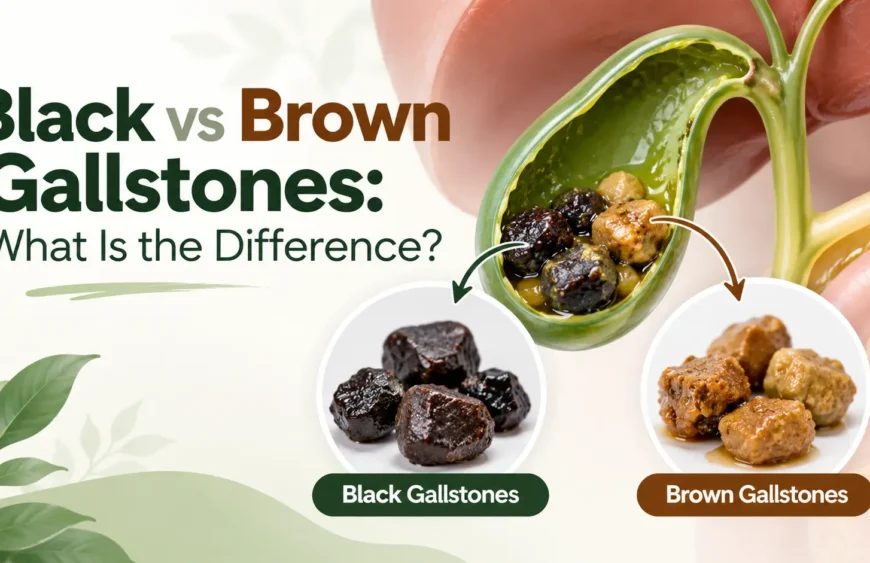
Gallstones are not all made of the same material. Some are mainly made of cholesterol, while others are pigment stones, which contain a higher proportion of bilirubin-related compounds.
Pigment gallstones are mainly divided into two types:
- Black pigment gallstones
- Brown pigment gallstones
Although both are called pigment stones, they form for different reasons and are usually found in different parts of the biliary system.
Black stones are mainly associated with increased bilirubin in bile, while brown stones are strongly associated with bile stasis and infection. Black stones usually form in the gallbladder, whereas brown stones are more commonly found in the bile ducts.
Understanding this difference can help explain why these stones develop and what doctors may look for when they are found.
What Are Pigment Gallstones?
To understand black and brown gallstones, it helps to first understand what a pigment stone is.
The liver produces bile, a digestive fluid that contains bile salts, cholesterol, bilirubin and other substances. Bile travels through the biliary system and helps the body digest fats.
Bilirubin is produced when red blood cells are broken down. The liver processes bilirubin and excretes it through bile.
When the chemical balance of bile changes, bilirubin can combine with calcium and other substances to form insoluble particles. Over time, these particles can accumulate and form pigment gallstones.
There are two main forms:
- Black pigment stones
- Brown pigment stones
The key difference between them is how they form and where they develop.
Black Gallstones
Black gallstones are a type of pigment stone that usually forms inside the gallbladder.
They are typically hard, brittle and dark black or greenish-black. Their main components include calcium bilirubinate and other calcium salts.
The formation of black stones is closely linked to an increased amount of bilirubin entering the bile.
How Do Black Gallstones Form?
One of the most important associations is chronic haemolysis.
Haemolysis means that red blood cells are being destroyed faster than normal. Since bilirubin is produced during the breakdown of red blood cells, long-term haemolysis can increase the amount of bilirubin reaching the bile.
This can promote the formation of calcium bilirubinate and eventually black pigment stones.
Black pigment stones are also associated with conditions such as:
- Chronic haemolytic disorders
- Cirrhosis
- Certain chronic liver diseases
- Increasing age
The important point is that black stones are generally related to bilirubin production and metabolism, rather than infection being the main cause.
What Do Black Gallstones Look Like?
Black pigment stones are generally:
- Dark black or greenish-black
- Hard
- Brittle
- Relatively small
- Irregular or rounded
Their appearance comes from their chemical composition. However, colour alone cannot reliably confirm the type of a gallstone.
Brown Gallstones
Brown gallstones are also pigment stones, but their formation is different from that of black stones.
They are generally softer and more greasy and are particularly associated with the bile ducts.
Brown pigment stones are closely linked to two factors: bile stasis and infection.
How Do Brown Gallstones Form?
Bile stasis means that bile is not flowing normally through the biliary system.
When bile becomes stagnant, bacteria can multiply more easily. Certain bacteria produce enzymes that alter bilirubin compounds in bile.
These chemical changes can cause bilirubin to precipitate and combine with calcium and fatty-acid salts, gradually forming brown pigment stones.
Brown pigment stones may therefore be associated with:
- Bile duct obstruction
- Biliary strictures
- Recurrent biliary infection
- Inflammation of the biliary tract
- Certain parasitic infections
So, while black stones are strongly associated with increased bilirubin availability, brown stones are more closely associated with poor bile flow and bacterial activity within the biliary system.
Why Do Brown Stones Often Form in the Bile Ducts?
This is one of the clearest differences between black and brown gallstones.
The bile ducts are narrow channels that carry bile from the liver and gallbladder to the small intestine.
When a duct becomes narrowed or blocked, bile can become stagnant. This creates conditions that favour bacterial growth and chemical changes in the bile.
As a result, brown pigment stones can develop directly within the biliary system.
A stone that forms within the bile duct is sometimes called a primary bile duct stone.
This differs from a stone that originally formed inside the gallbladder and later moved into the common bile duct, which is generally considered a secondary bile duct stone.
Black vs Brown Gallstones: Key Differences
|
Feature |
Black Gallstones |
Brown Gallstones |
|---|---|---|
|
Type |
Pigment stone |
Pigment stone |
|
Typical colour |
Black or very dark |
Brown |
|
Texture |
Hard and brittle |
Softer and greasy |
|
Usual location |
Gallbladder |
Often bile ducts |
|
Main chemical components |
Calcium bilirubinate and calcium salts |
Bilirubinate and calcium fatty-acid salts |
|
Main mechanism |
Increased bilirubin availability |
Bile stasis and bacterial activity |
|
Important associations |
Haemolysis, cirrhosis, age |
Infection, obstruction and bile stasis |
The easiest way to remember the difference is: Black pigment stones are mainly linked to bilirubin-related changes in bile, while brown pigment stones are strongly linked to impaired bile flow and infection.
Why Does the Difference Matter Clinically?
The type of pigment stone can give doctors clues about why it developed and where they should look for an underlying problem.
With black pigment stones, doctors may consider conditions associated with increased bilirubin production or altered bilirubin metabolism, such as chronic haemolysis or cirrhosis.
With brown pigment stones, attention may turn toward the biliary system, particularly possible obstruction, narrowing, infection or impaired bile flow.
This distinction does not diagnose an underlying disease by itself, but it provides useful clinical context.
It is also important to remember that the type or colour of a gallstone does not automatically determine how dangerous it is.
A stone can cause problems when it obstructs the normal flow of bile, regardless of whether it is black or brown.
For example:
- A stone blocking the cystic duct can cause acute cholecystitis, or inflammation of the gallbladder.
- A stone in the common bile duct is called choledocholithiasis.
- An infected and obstructed bile duct can cause acute cholangitis.
- A migrating gallstone can sometimes trigger gallstone pancreatitis.
This is why doctors consider the stone’s location, symptoms, obstruction and complications rather than relying on its colour alone.
How Are Black and Brown Gallstones Diagnosed?
Doctors do not usually determine whether a stone is black or brown simply by looking at an ultrasound.
Diagnosis begins with the patient’s symptoms and medical history and usually involves imaging.
Ultrasound
Abdominal ultrasound is commonly the first imaging test used when gallstones are suspected.
It can detect gallstones and provide information about their approximate size, number and location. It can also identify findings that may suggest gallbladder inflammation or bile duct dilation.
However, ultrasound generally cannot determine the exact chemical composition of a gallstone.
MRCP and EUS
If a bile duct stone is suspected, doctors may use magnetic resonance cholangiopancreatography (MRCP) or endoscopic ultrasound (EUS) to examine the biliary system in greater detail.
These tests can be particularly useful when the presence of a common bile duct stone is uncertain.
ERCP
Endoscopic retrograde cholangiopancreatography (ERCP) is an endoscopic procedure that can be used to treat certain bile duct problems.
When a stone is present in the common bile duct and ERCP is appropriate, the stone can often be removed during the procedure.
Does Treatment Depend on Whether the Stone Is Black or Brown?
Not entirely.
The type of stone can help explain its origin, but treatment decisions are usually based more heavily on:
- Whether the patient has symptoms
- Where the stone is located
- Whether bile flow is blocked
- Whether there is inflammation
- Whether there is infection
- Whether complications have developed
For example, an asymptomatic gallstone may not require immediate treatment.
When gallstones inside the gallbladder cause repeated symptoms or complications, cholecystectomy, or surgical removal of the gallbladder, may be recommended.
If a stone has moved into the common bile duct, treatment may instead focus on clearing the duct, which can involve ERCP in appropriate cases.
Brown pigment stones can be particularly important when associated with infection or obstruction because treating the underlying biliary problem is an important part of management.
Black vs Brown Gallstones: The Simple Takeaway
Black and brown gallstones are both pigment stones, but their underlying causes are different.
Black gallstones usually form in the gallbladder and are associated with increased bilirubin availability. Chronic haemolysis and cirrhosis are important clinical associations.
Brown gallstones are more closely associated with bile stasis, bacterial infection and problems affecting the bile ducts. They commonly develop within the biliary system when normal bile flow is disrupted.
So, the difference is not simply their colour.
It is mainly about how they form, where they form and what underlying conditions may be contributing to their formation.
At the same time, neither colour automatically tells you how serious the condition is. A stone that blocks a bile duct can cause significant complications regardless of whether it is black or brown.
Ayurvedic Support: Hepstome LFT
People dealing with gallstone-related concerns may also be interested in Ayurvedic approaches for supporting overall liver and digestive health.
Hepstome LFT is an Ayurvedic formulation that may be considered as a supportive option for people interested in Ayurvedic support.
However, supportive care should not be confused with treatment of a physical gallstone.
If a gallstone is causing obstruction, infection, inflammation, jaundice or significant pain, appropriate medical evaluation and treatment should not be delayed.
Hepstome LFT should therefore be considered supportive care and not a substitute for medical diagnosis or indicated treatment.
Conclusion
Black and brown gallstones are two types of pigment gallstones, but they develop through different mechanisms.
Black stones are generally associated with increased bilirubin availability and conditions such as chronic haemolysis and cirrhosis. Brown stones are more strongly associated with bile stasis, infection and problems within the bile ducts.
Recognising this difference can help doctors investigate possible underlying causes and understand the patient’s biliary condition.
For the patient, however, the most important questions are usually not simply “Is my stone black or brown?” but rather “Where is the stone, is it blocking anything, and is it causing symptoms or complications?”
Those factors help determine whether the gallstone can simply be observed or whether further investigation and treatment are needed.